
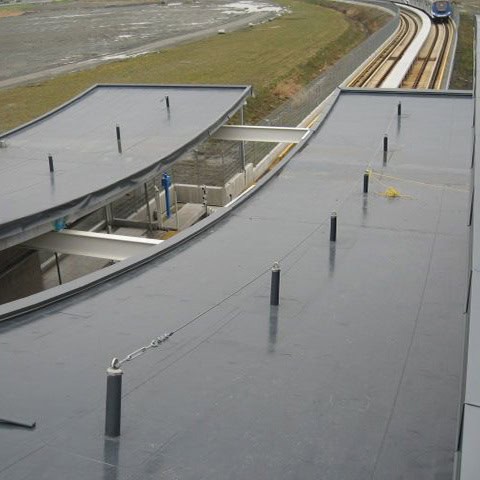
Horizontal lifeline systems (or just HLL for short) are the core of modern day rooftop fall protection. Safety isn’t an option when working at heights, there needs to be an engineered horizontal lifeline system to ensure OSHA standards are being met.
In this guide, we will cover all the horizontal lifeline requirements that you need to understand when using the mechanism.
What is the purpose of a horizontal lifeline system?
A horizontal lifeline system is designed to provide continuous horizontal fall protection for workers operating on rooftops or general heights. It allows users to safely move laterally while being securely connected to an anchorage point. A horizontal lifeline serves as a more practical safety application than a single point tie off by giving the workers more mobility.
HLL system components
Horizontal lifeline fall protection requires several key components to function for its intended purpose. These include:
Rooftop anchor points: The steel pier anchor is Pro-Bel’s specialty that we use to design a horizontal lifeline fall protection system. This type of safety equipment is permanently attached to the building’s rooftop.
In addition to steel pier anchors there are also permanent wall anchors and temporary anchors that can be used.
Lifeline (cable): The “lifeline” in horizontal lifeline fall protection refers to the cable that threads through the HLL system’s anchor points. It’s typically made of either stainless or galvanized steel.
Intermediate anchor support: Pro-Bel offers a range of intermediate support components including bolt through, cast-in-place, wrap around, weld or wall-mounted. This type of equipment is meant for a hands free horizontal lifeline system.
Shock absorber: This handy tool goes directly on the cable and reduces the fall arrest load applied back to the structure. It’s used for both hands free and double lanyard fall protection systems.
Horizontal lifeline checklist
- Identify the anchor points
- Make sure cable is an appropriate length
- Check there’s no visible damage on the lifeline components or the anchors
- Make sure horizontal lifeline is setup properly
HLL system safety requirements
For an HLL system to be able to do its job in the event of a fall, it must meet strict safety regulations.
- In the United States of America, the codes, regulations & standards that should be followed are:
- OSHA 1926, Subpart M
- ANSI Z359.6-2016
- ANSI A10.32-2012
Canada has different regulations, codes and standards compared to the US. The standards followed are:
- Different provinces specify different height requirements for fall protection (it should be noted that the fall protection system in place doesn’t necessarily have to be an HLL).
Alberta: 3.0m
British Columbia: 3.0 m
Manitoba: 3.0 m
Newfoundland: 3.05 m
New Brunswick: 3.0 m
Nova Scotia: 3.0 m
Northwest Territories & Nunavut: 3.0 m
Ontario: 3.0 m
Prince Edward Island: 3.0 m
Quebec: 3.0 m
Saskatchewan: 3.0 m
Yukon Territory: 3.0 m
- CSA Z259.16-21
For more information on Canadian codes, standards and regulations read the FAQ.
Benefits of an HLL system
There’s a lot of benefits to horizontal lifeline fall protection. Some, but not all, key benefits include:
- Greater mobility for rooftop workers: The traditional single point tieback anchors limit a workers mobility to a fixed location on the rooftop. But HLL systems grant workers continuous horizontal mobility, so a worker isn’t limited to being stuck in one spot.
- Enhanced worker safety: These systems can be used for both fall arrest and fall restraint. To learn between the two, read here.
- Improved productivity without sacrificing safety: By minimizing the need for rooftop workers to dis and re-connect while moving, workflow becomes more streamlined.
- Versatile design: These systems aren’t just used on rooftops, but any architecctural structure with a fall risk. This includes elevator shafts, industrial facilities, bridges, etc.
When HLL systems are required
An engineered horizontal lifeline system should be used in any situation where a worker risks injuring themselves from a fall. However, in terms of when an HLL or an equivalent system is required, there are a few instances.
1. When there’s expected to be routine or potential ongoing rooftop maintenance within the hazard zone
An example of routine maintenance can include cleaning drains or removing debris from gutters. An example of potential ongoing rooftop maintenance includes the maintenance of HVAC units or exhaust fans, rooftop gardens, facade access equipment such as window washing davits or standard anchors, a necessary post-storm review, etc.
When that sort of equipment is within the hazard zone, it becomes a risk for the employee’s life. A fall protection system such as a singlepoint tieback or an engineered horizontal lifeline needs to be in place.
2. Inspecting & maintaining safety equipment
Lots of rooftop equipment needs inspecting — even the anchors you tie off on need to be inspected. The efficiency of horizontal lifeline fall protection depends on its integrity to the structure and thus needs to be visually inspected annually & recertified every 5-10 years.
The anchors used for HLL systems can have additional purposes, such as being used for window washing equipment. Most low-to-mid-rise buildings that need rope descent for window cleaning or general facade access use standard pier tieback anchors or wall anchors.
Building owners or facility managers are required to schedule an annual roof anchor inspection unless they want to risk a full liability lawsuit. Buildings that substitute tieback anchors for a guardrail aren’t exempt — they will also need to be inspected.
3. Active construction sites
A lot of fall hazards are introduced throughout the building process and an engineered horizontal lifeline acts as both a fall arrest system and a fall restraint system. The inherent adaptability and mobility of the system makes it an asset to any construction site.
4. Manufacturing facilities
In a lot of industrial settings, workers may need to access an elevated platform to access machinery. HLL systems are implemented in these cases to protect the employee from a fall.